
Significance of Mahalaya Amavasya 2026
Mahalaya Amavasya 2026 falls on Saturday, 10 October 2026. It is one of the most significant days in Hindu tradition for remembering departed ancestors, fulfilling ancestral responsibilities and praying for their peace and spiritual elevation.
Mahalaya Amavasya marks the conclusion of Mahalaya Paksha, the sacred period dedicated to the Pitrus. It is also known as Sarva Pitru Amavasya, Pitru Moksha Amavasya and Pitru Paksha Amavasya.
Quick Overview: Significance of Mahalaya Amavasya 2026
Key Date: Saturday, 10 October 2026.
Spiritual Purpose: Honour all known and unknown ancestors, fulfill
Pitru Rina (ancestral gratitude), and seek ancestral peace.
Key Vedic Rituals: Personalized Mahalaya Amavasya Pooja and
Thila Homam with individual Name,
Nakshatra, and Gothra Sankalpam at Swami Narayanan Temple.
Significance of Mahalaya Amavasya 2026
Mahalaya Amavasya 2026 falls on Saturday, 10 October 2026. It is one of the most significant days in Hindu tradition for remembering departed ancestors, fulfilling ancestral responsibilities and praying for their peace and spiritual elevation.
Mahalaya Amavasya marks the conclusion of Mahalaya Paksha, the sacred period dedicated to the Pitrus. It is also known as Sarva Pitru Amavasya, Pitru Moksha Amavasya and Pitru Paksha Amavasya.
Families observe this day through Mahalaya Amavasya Pooja, Thila Homam, charitable offerings and prayers performed in memory of their ancestors.
For the complete date and Muhurtham information, read our Mahalaya Amavasya 2026 Date and Timings guide.
What Is the Spiritual Meaning of Mahalaya Amavasya?
The spiritual meaning of Mahalaya Amavasya is centred on remembrance, gratitude and responsibility towards one’s ancestors.
According to Hindu tradition, every individual carries three important spiritual obligations:
- Deva Rina – gratitude towards the divine.
- Rishi Rina – gratitude towards sages and spiritual teachers.
- Pitru Rina – gratitude towards parents and ancestors.
Pitru Rina reminds us that our life, family identity, values and opportunities are connected to the sacrifices made by earlier generations.
Mahalaya Amavasya 2026 gives descendants a sacred opportunity to acknowledge this ancestral connection and perform prayers for the peace of departed family members.
Why Is Mahalaya Amavasya So Important?
Mahalaya Amavasya is considered especially important because it is dedicated collectively to all ancestors, including those whose exact death Tithi may be unknown.
Families traditionally observe this day when:
- An ancestor’s exact death Tithi is not known.
- Ancestral prayers could not be performed earlier.
- A family member died suddenly or under difficult circumstances.
- The required final rituals were incomplete.
- The family wants to honour all known and unknown ancestors.
- A priest or astrologer has recommended Pitru Dosha Pariharam.
- Similar difficulties appear to continue across generations.
The purpose of the observance is not based on fear. It is an expression of compassion, gratitude and respect for the family lineage. Book a personalized Mahalaya Amavasya Pooja to fulfil this sacred duty.
Why Is Mahalaya Amavasya Called Sarva Pitru Amavasya?
The word “Sarva” means “all,” while “Pitru” refers to departed ancestors.
Mahalaya Amavasya is called Sarva Pitru Amavasya because prayers may be offered collectively for:
- Departed parents.
- Grandparents and great-grandparents.
- Known and unknown ancestors.
- Family members whose death Tithi is forgotten.
- Departed relatives who had no descendants to pray for them.
- Souls for whom the necessary ancestral rituals were not completed.
Therefore, Mahalaya Amavasya Pooja is not restricted to remembering only one departed person. It is traditionally observed for the peace of the entire ancestral lineage.
Significance of Thila Homam on Mahalaya Amavasya
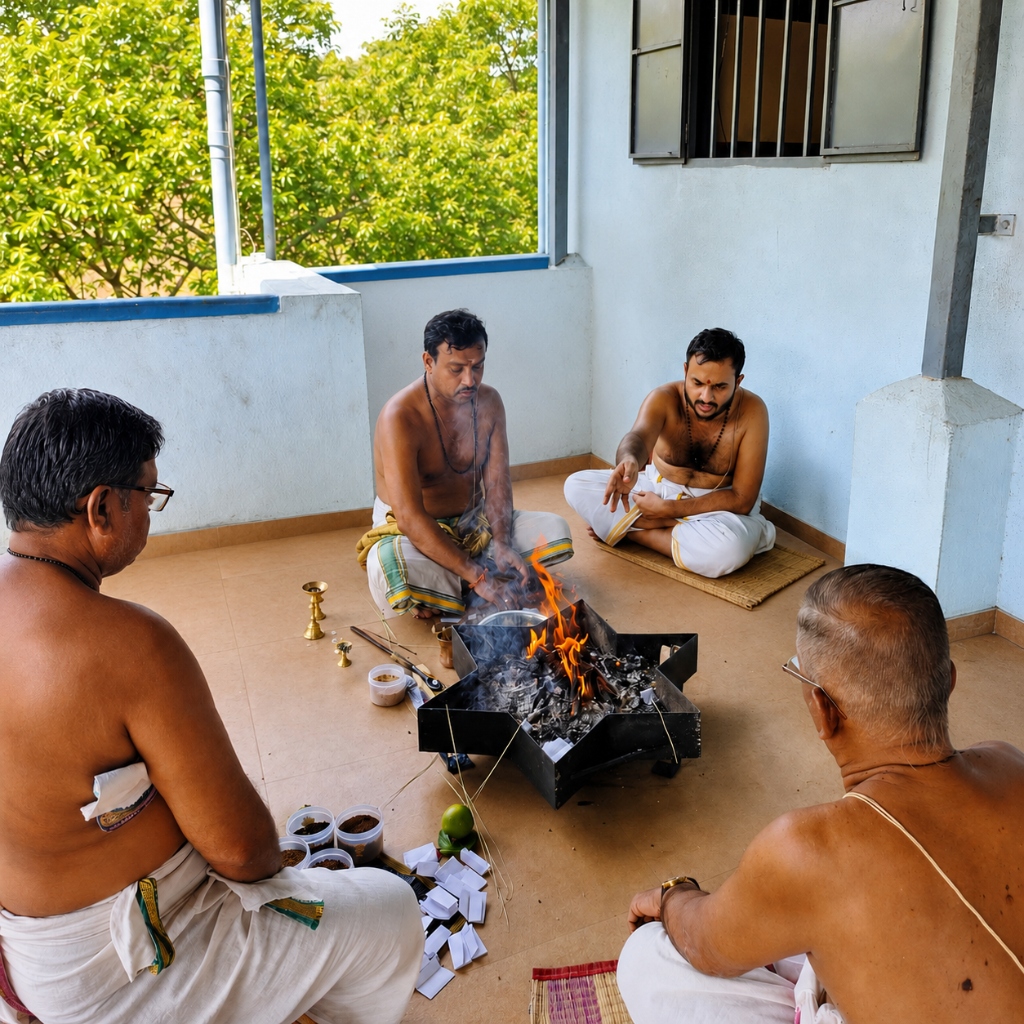
Thila Homam is one of the principal Vedic rituals performed at Swami Narayanan Temple on Mahalaya Amavasya 2026.
The word “Thila” means sesame. During the Homam, black sesame and other prescribed materials are offered into the sacred fire while trained Vedic priests chant mantras for departed ancestors.
Primary Objectives of Thila Homam
Thila Homam is traditionally performed to:
- Pray for peace and spiritual liberation of ancestors.
- Fulfil unresolved ancestral responsibilities.
- Address Pitru Rina and Pitru Dosha.
- Seek forgiveness for omitted ancestral observances.
- Pray for ancestors experiencing karmic suffering.
- Seek ancestral grace for the present family.
- Protect the wellbeing of future generations.
The sacred fire acts as the medium through which prayers and offerings are symbolically submitted to the divine and the Pitru Devatas.
Mahalaya Amavasya and the 28 Narakas
Hindu sacred traditions describe 28 principal Narakas, representing different states of karmic suffering experienced by souls according to their actions.
According to traditional belief, Thila Homam performed with proper Vedic mantras and a sincere Sankalpam helps departed ancestors receive spiritual relief from suffering associated with these 28 Narakas.
The ritual is performed with prayers that the ancestors may:
- Receive relief from painful karmic conditions.
- Be freed from unresolved spiritual suffering.
- Attain peace and spiritual elevation.
- Progress towards a higher spiritual state.
- Bestow their blessings upon their descendants.
Connection Between Mahalaya Amavasya and Pitru Dosha
Pitru Dosha is traditionally understood as an unresolved ancestral obligation or karmic influence connected with a family lineage. It should not automatically be viewed as an ancestral curse.
According to Vedic astrology, possible indications associated with Pitru Dosha may include:
- Similar problems repeating across generations.
- Delays in marriage.
- Difficulties related to childbirth.
- Persistent family disagreements.
- Lack of stability despite continuous effort.
- Repeated interruptions in career or business.
- Disturbing dreams involving departed relatives.
- A continued feeling that ancestral duties remain incomplete.
These circumstances alone do not confirm Pitru Dosha. A horoscope and the family’s circumstances should be examined by a knowledgeable astrologer or priest before selecting any Pariharam.
Mahalaya Amavasya Pooja and Thila Homam are traditionally recommended as important spiritual remedies for ancestral obligations.
Benefits of Mahalaya Amavasya Pooja and Thila Homam
According to Hindu tradition, devotees perform these rituals to:
- Pray for the liberation of departed ancestors.
- Seek relief for ancestors from karmic suffering.
- Fulfil Pitru Rina and ancestral responsibilities.
- Reduce the spiritual effects of Pitru Dosha.
- Seek peace and harmony within the family.
- Pray for the removal of long-standing obstacles.
- Seek progress in marriage and family life.
- Pray for blessings related to children and future generations.
- Seek stability in career, business and finances.
- Receive ancestral grace and spiritual protection.
* Spiritual outcomes depend on faith, tradition and individual circumstances and should not be presented as guaranteed material results.
Why Should the Pooja Be Personalized?
The Sankalpam establishes for whom and for what purpose the pooja is being performed.
At Swami Narayanan Temple, every Mahalaya Amavasya Pooja and Thila Homam is performed using the devotee’s:
- Name
- Nakshatra
- Gothra
- Family details
- Available names of departed ancestors
- Specific prayer or Pariharam requirement
A personalized Sankalpam ensures that the ritual is dedicated to the individual devotee and family rather than being conducted as a common group Sankalpam. Arrange your personalized Mahalaya Amavasya Pooja here.
How Mahalaya Amavasya Is Observed at Swami Narayanan Temple
Swami Narayanan Temple performs personalized Mahalaya Amavasya Pooja and Thila Homam according to prescribed Vedic procedures.
Temple Pooja Features
- Individual or family Sankalpam.
- Never a common group Sankalpam.
- Mahalaya Amavasya Pooja performed separately.
- Thila Homam with black sesame offerings.
- Correct Vedic mantras.
- Trained and dedicated Vedic priests.
- Rituals performed during the proper Muhurtham.
- Live online participation from anywhere.
- Personal pooja video provided as proof.
- Guidance for devotees whose Gothra or ancestral details are unknown.
Can Mahalaya Amavasya Pooja Be Performed Online?
Yes. Devotees living in India or abroad can arrange a personalized online Mahalaya Amavasya Pooja and Thila Homam.
The temple performs the ritual using the devotee’s submitted Sankalpam details. The family can join the pooja live from their home and receive a personal pooja video after completion.
This allows NRI families and devotees unable to travel to continue their ancestral traditions from anywhere in the world. Register for online Mahalaya Amavasya Pooja.
Honour Your Ancestors on Mahalaya Amavasya 2026
Mahalaya Amavasya is an opportunity to remember the people whose lives, sacrifices and blessings shaped your family. Perform a personalized Mahalaya Amavasya Pooja and Thila Homam to pray for your ancestors’ peace, spiritual elevation and liberation.
- Only Personalized Poojas
- Individual Name, Nakshatra and Gothra Sankalpam
- Never a group pooja
- Dedicated Vedic priests & proper Muhurtham
- Join live from anywhere with personal pooja video proof
Explore Mahalaya Amavasya Pooja Guides
Learn more about Mahalaya Amavasya, Thila Homam and personalized ancestral pooja services:
Frequently Asked Questions
Find answers to common questions about the significance of Mahalaya Amavasya 2026, Thila Homam rituals, Pitru Dosha, and online bookings.
1. What is the significance of Mahalaya Amavasya 2026?
Mahalaya Amavasya 2026 is a sacred occasion for remembering all departed ancestors, fulfilling Pitru Rina and praying for their peace and spiritual liberation.
2. When is Mahalaya Amavasya in 2026?
Mahalaya Amavasya falls on Saturday, 10 October 2026.
3. Why is Mahalaya Amavasya important for ancestors?
Hindu tradition considers it a powerful day for offering personalized prayers and performing Thila Homam for the peace and spiritual elevation of known and unknown ancestors.
4. What is the importance of Thila Homam?
Thila Homam uses black sesame offerings and Vedic mantras to pray for ancestral peace, relief from karmic suffering and fulfilment of ancestral responsibilities.
5. Does Thila Homam provide relief from the 28 Narakas?
According to Hindu religious belief, Thila Homam is performed to pray for ancestors to receive relief from suffering associated with the 28 Narakas and attain spiritual elevation.
6. Is Mahalaya Amavasya Pooja performed for only one ancestor?
No. The pooja may include prayers for parents, grandparents and all known or unknown ancestors belonging to the family lineage.
7. Can Mahalaya Amavasya Pooja help with Pitru Dosha?
According to Vedic tradition, Mahalaya Amavasya Pooja and Thila Homam are important Pitru Dosha Pariharams performed to address unresolved ancestral obligations.
8. Can the pooja be performed if an ancestor’s death Tithi is unknown?
Yes. Mahalaya Amavasya is traditionally considered suitable for remembering ancestors whose exact death Tithi is unknown.
9. What details are required for the pooja?
Devotees should provide their Name, Nakshatra and Gothra, along with the available names and relationships of departed family members.
10. What if my Gothra is unknown?
Inform the temple while booking. A Vedic priest will guide you regarding the appropriate Sankalpam procedure.
11. Can NRIs participate in Mahalaya Amavasya Pooja?
Yes. NRI devotees can participate live online, and the ritual will be performed with their personalized Sankalpam.
12. Is Mahalaya Amavasya Pooja a group pooja?
No. Swami Narayanan Temple performs it with an individual or family Sankalpam, never as a common group Sankalpam.