Etymology & Spiritual Definition
Meaning of Soora Samharam: Destruction or Divine Grace?
The term Soora Samharam is composed of two sacred words:
- Soora (or Sura): Represents the Asura emperor Surapadman, who epitomized supreme pride, unchecked worldly power, and deep-seated cosmic arrogance.
- Samharam: In popular parlance, "Samharam" translates to annihilation or destruction. However, in authentic Shaivite and Vedic theological philosophy (Shaiva Siddhanta), Samharam signifies purification and dissolution into the Divine.
Unlike mortal warfare driven by malice or territorial ambition, Lord Murugan's battle was an act of Paramanugraha (Supreme Grace). In Hinduism, the Lord never harbors hatred toward any being, including demons. The soul (Atma) of Surapadman was pure; it was only his colossal ego (Anava Malam) that needed to be dissolved.
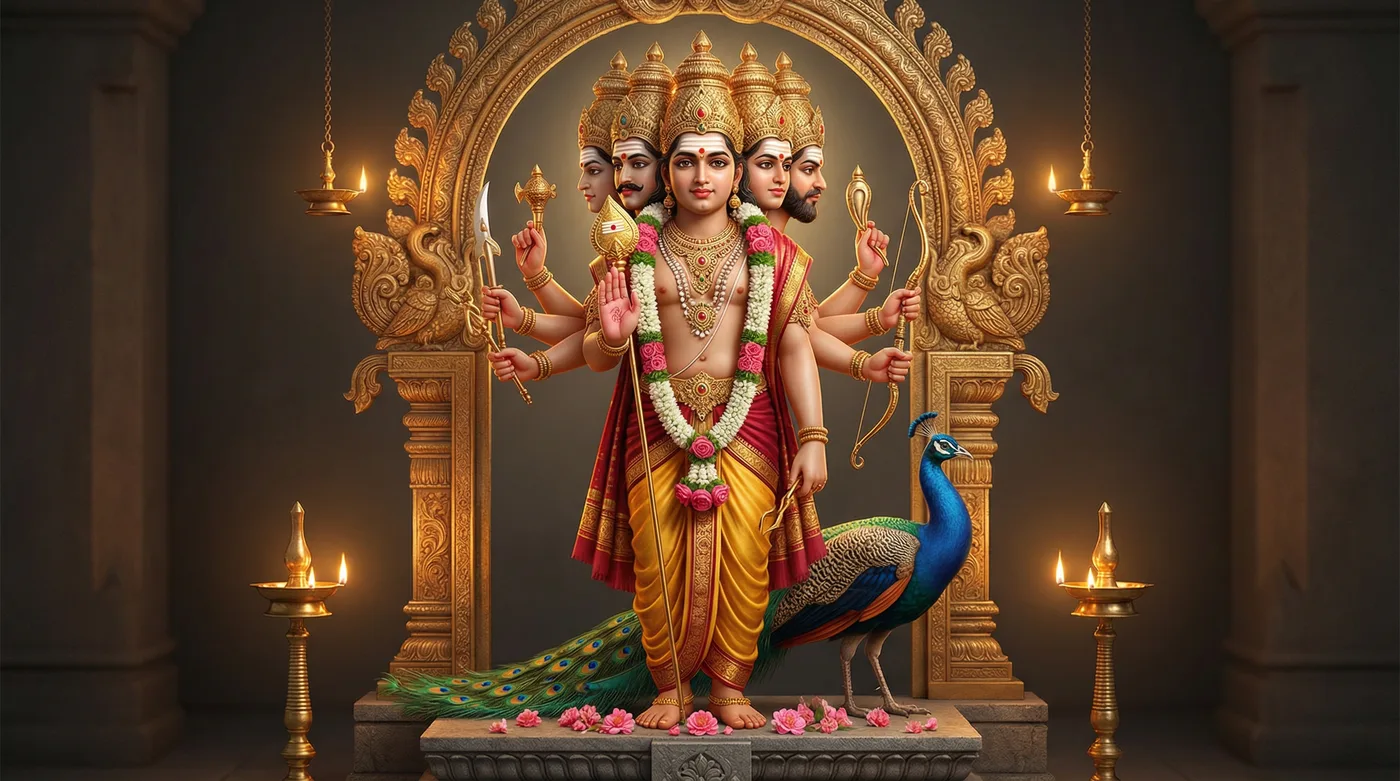
When the divine spear pierced Surapadman, the demon did not perish into oblivion. Instead, his dark ego was completely burned away, leaving behind pure devotion. Lord Murugan embraced him, taking one half of his transformed being as His vehicle—the Peacock (Mayil), representing mastery over pride and beauty—and the other half as His battle standard—the Rooster (Seval), representing the awakening herald of divine consciousness.
The Principle of Divine Anugraha
"Lord Subramanya does not destroy his enemies; He destroys the enmity and arrogance within them. By absorbing Surapadman into His permanent presence as His vehicle and flag, Murugan demonstrated that true victory lies in spiritual redemption, not violent extinction."
Scriptural History
The Sacred Legend: The Epic Battle of Tiruchendur
The narrative of Soora Samharam is detailed in the Skanda Purana and its celebrated Tamil rendition, the Kanda Puranam composed by Saint Kachiappa Sivachariyar.
Surapadman, alongside his formidable brothers Tarakasuran and Simhamukhan, performed intense tapasya (austerities) to Lord Shiva. Granted boons of near-invulnerability, they conquered the three worlds, driving the Devas (celestials) into servitude and imprisoning Indra’s son, Jayanta.
Birth of the Divine General (Senani)
Unable to endure the tyranny, the celestials sought refuge in Lord Shiva. From the Third Eye (Jnana Netra) of Lord Shiva emerged six divine sparks of radiant energy. These sparks were carried by Vayu (Wind God) and Agni (Fire God) to the holy Saravana Poigai lake, where they manifested into six divine infants nurtured by the Kartika maidens. Goddess Parvati embraced the six infants into one divine youth with six faces and twelve hands—hence known as Shanmukha and Skanda.
To empower Her divine child for the cosmic mission, Goddess Parvati bestowed upon Him the unconquerable Vel (Spear)—imbued with Her entire shakti (transcendental energy)—at the holy shrine of Sikkal (Singaravelan).
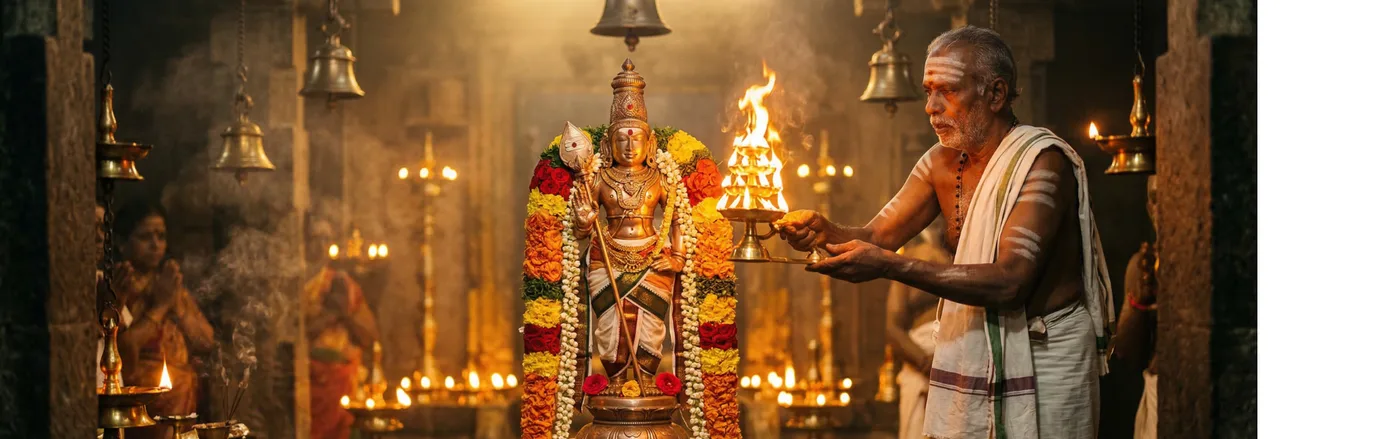
Lord Shanmukha with the Divine Jnana Vel
The Six-Day War at Veera Mahendrapuram
Lord Murugan marched with His celestial forces, accompanied by Veerabahu and his nine valorous commander brothers. Before waging war, Lord Murugan dispatched Veerabahu as an envoy of peace to give Surapadman an honorable opportunity to release the prisoners and choose Dharma. Blinded by pride, Surapadman rejected the counsel.
Over the course of six days, the decisive battles took place:
- Fall of Tarakasuran: On the early days of battle, Lord Murugan shattered the Krauncha mountain fortress and vanquished Tarakasuran.
- Fall of Simhamukhan: Surapadman’s second brother fought fiercely, taking various monstrous forms, before Murugan's Vel severed his head. With divine grace, Simhamukhan was transformed into the Lion vahana of Goddess Durga.
- The Final Sea Battle at Tiruchendur: On the sixth day (Sashti), Surapadman utilized black illusions (Maya), shifting into terrifying beasts, whirlwinds, and oceanic phantoms. Realizing his defeat was imminent, he transformed into an immense, unyielding Mango Tree (Maamaram) deep in the sea.
- The Piercing of the Vel: Lord Murugan hurled the blazing Vel. The sacred spear cleaved the cosmic mango tree cleanly into two halves. Instead of death, Surapadman received the ultimate enlightenment: one half emerged as the proud Peacock (which prostrated beneath the Lord's feet to carry Him), and the other half emerged as the crowing Rooster (which flew to the top of His flagstaff to herald the Lord's glory forever).
Esoteric Shaivite Philosophy
The Inner Meaning: Conquering the Three Malas (Impurities)
Beyond the outer mythological narrative, Soora Samharam carries profound psychological and spiritual significance for every human being. In Shaiva philosophy, the human soul is constrained by three fundamental impurities called the Mummalam (Three Malas). The three demons vanquished by Lord Murugan represent these exact internal obstacles:
Anava Malam
Represented by Surapadman
The primordial ego, arrogance, and the stubborn illusion of "I" and "Mine". It blinds a person from recognizing the Divine within and around them.
Maya Malam
Represented by Simhamukhan
The veil of delusion, false identity, sensory infatuation, and attachment to transient material possessions that cause deep mental bondage.
Karma Malam
Represented by Tarakasuran
The accumulated impressions of past selfish deeds, destructive desires, and karmic debts that continually trap the soul in cycles of suffering.
The Divine Vel as the Lance of Wisdom (Jnana)
Human willpower alone is often incapable of defeating deeply rooted ego and karmic tendencies. This is why Goddess Parvati granted Murugan the Vel. The anatomy of the sacred Vel reflects the ideal spiritual intellect:
- Broad Body (Agalam): Symbolizes broadness of mind, infinite compassion, and universal love.
- Deep Base (Aazham): Symbolizes depth of spiritual knowledge, contemplation, and Vedic grounding.
- Sharp Tip (Koor): Symbolizes laser-sharp intellect (Viveka), discernment, and the ability to pierce through delusions.
By participating in Soora Samharam rituals, devotees pray for Lord Murugan’s Vel to pierce through their inner anxiety, jealousy, doubts, and karmic blocks, illuminating their hearts with fearlessness and spiritual clarity.
Auspicious Calendar
Soora Samharam 2026: Date, Tithi & Muhurtham Timings
Soora Samharam is observed on the Sashti Tithi of Shukla Paksha (waxing moon) during the Tamil month of Aippasi (Karthika Masam in the North Indian and Telugu calendars).
| Event / Ritual |
Gregorian Date |
Tamil Calendar / Tithi |
Significance |
| Skanda Sashti Day 1 |
Tuesday, 10 Nov 2026 |
Aippasi Shukla Prathama |
Vratam commences; Kalasha Sthapana & fast begins |
| Skanda Sashti Day 2 - 4 |
11 Nov – 13 Nov 2026 |
Dwitiya, Tritiya, Chaturthi |
Continuous recitation of Kanda Sashti Kavacham & Japa |
| Skanda Sashti Day 5 |
Saturday, 14 Nov 2026 |
Aippasi Shukla Panchami |
Sikkal Singaravelan receiving the divine Vel from Parvati |
| Soora Samharam (Day 6) |
Sunday, 15 Nov 2026 |
Aippasi Shukla Sashti |
Vanquishing of Surapadman; Grand evening victory homam |
| Thirukalyanam (Day 7) |
Monday, 16 Nov 2026 |
Aippasi Shukla Saptami |
Celestial wedding of Lord Murugan & Goddess Deivanai |
Auspicious Timings for 15 November 2026:
- Sashti Tithi Begins: Afternoon of Saturday, 14 November 2026
- Sashti Tithi Ends: Evening of Sunday, 15 November 2026
- Soora Samharam Muhurtham: Conducted during the sacred Sandhya / Sayarakshai (dusk) period between 5:00 PM and 7:15 PM IST, corresponding to the traditional hour when Lord Murugan manifested the final victory at Tiruchendur.
Devotional Practices
Skanda Sashti Fasting Rules & Soora Samharam Rituals
Devotees across the world observe the sacred 6-day Skanda Sashti Vratam leading up to Soora Samharam. The fasting disciplines help cleanse physical toxins, sharpen mental concentration, and align the devotee's consciousness with Lord Subramanya's protective grace.
Types of Fasting (Vratam) Disciplines:
- Kaduva Vratam (Full Water Fast): The most austere discipline, consuming only water for the full six days (practiced only by experienced sadhakas under health supervision).
- Milagu Vratam (Single Pepper Fast): A traditional Tamil ascetic practice of consuming a single black pepper grain and water.
- Phalahara Vratam (Fruits & Milk): The most popular and accessible discipline for working householders—consuming fresh fruits, tender coconut water, and cow milk once or twice a day while refraining from grains and cooked meals.
- Eka-Bhukta Vratam (Single Meal): Consuming a single, sattvic, salt-restricted vegetarian meal at noon, followed by liquid diet in the evening.
Pooja Vidhi on Soora Samharam Day:
- Morning Abhishekam: Cleanse the Murugan idol or Vel with pure water, milk, panchamirtham, tender coconut, vibhuti (sacred ash), and sandalwood paste.
- Vel Alankaram: Adorn the sacred Vel with fresh red oleander (*Semparuthi*), jasmine, or lotus flowers. Red is sacred to Lord Murugan, symbolizing fiery determination and courage.
- Chanting Sacred Hymns: Recite the powerful Kanda Sashti Kavacham by Devaraya Swamigal at least 6 or 36 times. Recite the Subramanya Bhujangam composed by Adi Shankaracharya to dissolve fear and diseases.
- Shatru Samhara Trishati Homam: In temples and consecrated shrines, Vedic priests perform the powerful Shatru Samhara Homam into the sacred Agni fire with ghee, red flowers, and 300 specific Shanmukha mantras to neutralize evil-eye and hostile adversaries.
- Evening Fast Breaking: After witnessing the Soora Samharam ritual and receiving the sacred Vibhuti Prasad in the evening, devotees break their 6-day fast by drinking blessed milk or coconut water.
Divine Remedies & Blessings
Spiritual and Life Benefits of Soora Samharam Pooja
In Vedic astrology and Agamic tradition, Lord Murugan governs Mars (Mangal / Angaraka), the planet of valor, land, defense, sibling unity, and victory over adversaries. Performing or sponsoring an authentic Soora Samharam Pooja brings multifaceted blessings:
Shield Against Evil Eye & Negative Energy
Neutralizes toxic jealousy (Kandrishti), black magic suspicions, chronic household discord, and oppressive energetic disturbances.
Support in Legal Disputes & Court Cases
Traditionally invoked for courage, truthful vindication, and divine justice when entangled in protracted litigation or false allegations.
Relief from Office Politics & Hidden Enemies
Protects your reputation against workplace conspiracies, toxic colleague jealousy, stalled promotions, and unjust professional hostility.
Commercial Victory & Overcoming Rivalry
Helps business owners and entrepreneurs eliminate malicious commercial sabotage, client poaching, cashflow blocks, and recurring trade losses.
Eradication of Fear, Anxiety & Depression
Replaces persistent phobias, panic, and lack of self-confidence with vibrant mental clarity, inner lion-hearted courage, and peace.
Planetary Relief (Mars / Kuja & Rahu-Ketu Dosha)
Calms volatile Mars afflictions (Angaraka / Manglik Dosha) affecting marriage or property, and pacifies intense Rahu-Ketu karmic imbalances.
Frequently Asked Questions
Devotee Questions About Soora Samharam
Here are answers to the most common questions devotees ask about Soora Samharam history, fasting rules, and ritual procedures:
Soora Samharam is the grand climax of the six-day Skanda Sashti festival. It celebrates the victory of Lord Murugan over the demon Surapadman at Tiruchendur. It is celebrated to commemorate the triumph of righteousness (Dharma) over evil, light over darkness, and divine wisdom over human ego.
When Lord Murugan cleaved the sea-dwelling mango tree into two halves, His divine grace transformed one half into a Peacock (Mayil) and the other into a Rooster (Seval). The peacock became His divine vehicle, representing the beauty of creation submissive to the Divine, while the rooster became the emblem on His flag, greeting the morning sun and announcing the dawn of spiritual awakening.
Soora Samharam will be celebrated on Sunday, 15 November 2026. The special victory muhurtham rituals take place during the evening dusk (Sayarakshai / Sandhya) between 5:00 PM and 7:15 PM IST.
Yes. While observing all six days of Skanda Sashti Vratam is ideal, scriptures state that devotees who are unable to do so due to health, work, or travel can observe a strict fast on the sixth day (Soora Samharam day) alone and participate in the evening pooja to receive immense divine blessings.
The day following Soora Samharam (Monday, 16 November 2026) is celebrated as Thirukalyanam—the divine wedding of Lord Murugan with Goddess Deivanai (daughter of King Indra). It symbolizes the harmonious union of the soul (Jivatma) with the Supreme Divine (Paramatma) after all obstacles and egos have been dissolved.
Lord Murugan is revered as the Commander-in-Chief of cosmic forces (*Deva Senapati*). His blessings are sought in Vedic astrology to alleviate harsh planetary conflicts, subdue malicious enemies, grant eloquence and clear mental perception, and dispel conspiracies created by jealous opponents.
Swaami Narayanan Temple provides 100% individual online ritual bookings. Devotees in the USA, UK, Canada, Australia, Singapore, Malaysia, and worldwide can provide their Name, Rashi, Nakshatra, and Gothram for personalized Sankalpam. Devotees can join live via WhatsApp or Zoom, and complete HD video recordings and photos are shared directly.
Soora Samharam is the annual festival celebration marking the historical defeat of Surapadman during Skanda Sashti. Shatru Samhara Homam (or Trishati Pooja) is the specific Vedic fire ritual performed using 300 sacred mantras of Lord Subramanya that can be performed during Soora Samharam or on any Tuesday / Sashti / Krittika star to conquer enmity and obstacles.